





Someone managing a long-term condition spends a few minutes a year with a clinician, and the rest of the year in search results, group chats, videos, and conversations with people who have the same diagnosis. What they decide to do about their health forms across all of it.
Infodemic management came out of the COVID-19 response and is built for acute events. It gave public health a set of methods for understanding what is circulating and for acting on it. The everyday conditions in which people form their relationship with the health system, through routine care, prevention and chronic disease management, sit outside what it was designed for.
This page sets out what an infodemic is, what infodemic management does, and where it fits in the wider work of a health system. I led this work at WHO during the COVID-19 response, and much of what follows comes from that period.
What is an infodemic?
WHO has defined the infodemic as an overabundance of information, accurate or not, in the digital and physical space, accompanying an acute health event such as an outbreak or epidemic.
That definition is scoped to acute events, which is what it was written for. The information environment people live in is continuous, and the same dynamics operate between outbreaks as during them.
What is infodemic management?
Infodemic management is the systematic use of risk- and evidence-based analysis and approaches to promote a healthier information environment and resilience against infodemic impacts on health behaviours during health emergencies.
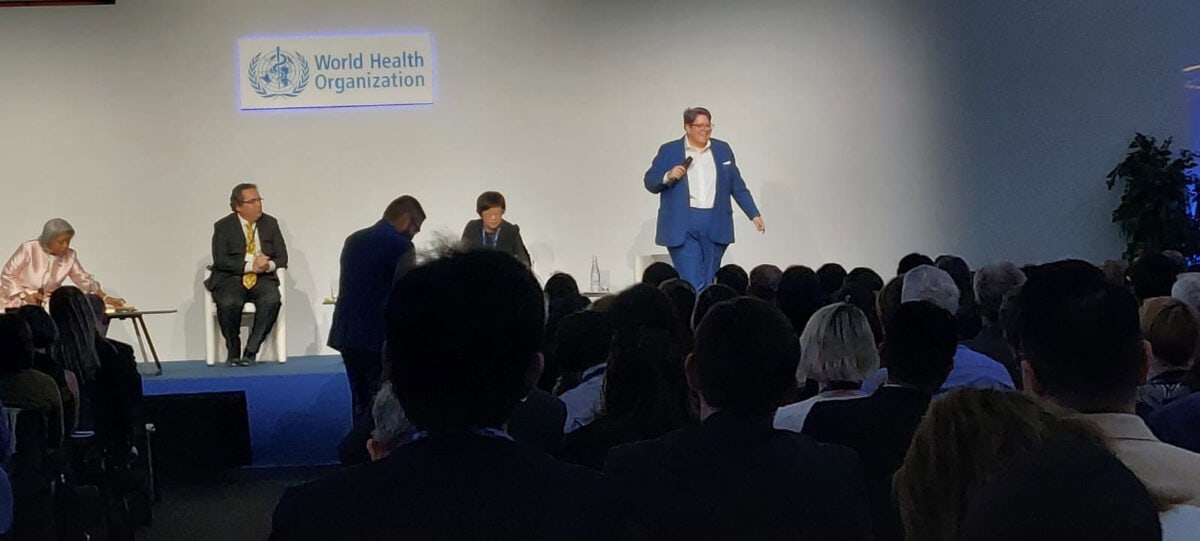
Here is a talk I gave in 2023 on why health departments should invest in infodemic management.
What does an infodemic manager do?
An infodemic manager’s job is to understand the information environment around a particular health topic and how it may impact people’s perceptions, behaviors and narratives. These can range from vaccine confidence to ebola outbreaks, to cancer, to mental health, to sexual and reproductive health.
The role grew out of the COVID-19 pandemic and other public health responses. An infodemic manager’s job is to understand this information environment and advise a health program on how to better address people’s information needs, including questions, concerns, information voids and circulating mis/disinformation and narratives.
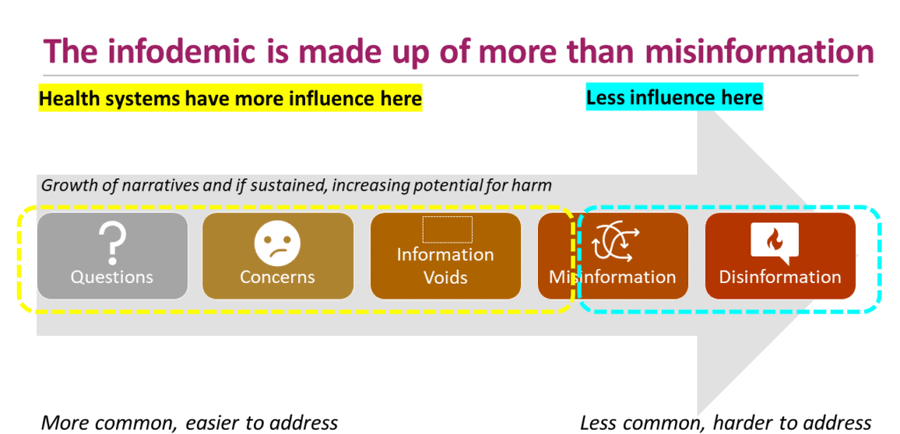
An infodemic manager is not the promoter of their organization, manager of the reputation of senior health officials, or trying to fix the internet to only include positive information about health topics. Their job is not to take down misinformation or advocate anything that infringes on freedom of expression.
If there’s a gap between the recommended health guidance and what people are seeing, doing and discussing, there might be a lot of noise. This makes it difficult for people to access, understand and act on credible and accurate health information.

Every day, we are bombarded by information from all directions, including our phones, from our social media, the news, family and friends, community leaders and influencers, and health care workers. Not all this information is credible, accurate or up to date. It may include mis or disinformation or narratives that are harmful for health and well-being (advocating following professional health advice, promoting skepticism of science, stigma, advocating violence against health workers, deceptive marketing of health products, etc).
This space between the information environment, health system and people seeking health services is where the infodemic manager works.
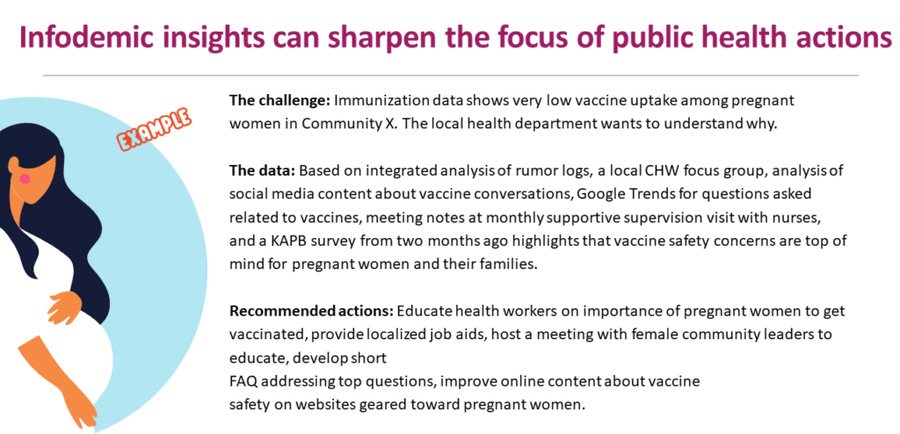
A health system earns credibility through how it delivers care
People are vulnerable to health mis- and disinformation because both their health service and information needs are not met. No matter how much it communicates, a health system will not be credible and not enjoy trust (especially from communities experiencing vulnerability) if it does not design and deliver health services in ways that people need.
- Sometimes people assume that infodemic management is simply about health communications. Communication is critical but insufficient for addressing infodemics or fostering a healthier information environment. This is because communications can’t address operational programmatic challenges that cause or contribute to poor service delivery and distrust in the communities we serve.
- Sometimes people assume that infodemic management is simply about behavioral insights. However, behavioral science can’t address health system and structural challenges that cause health information inequalities in the information ecosystem.
- Sometimes people assume that infodemic management is simply about digital engagement and technology solutions. However, information swarms in between online and offline spaces, and tech-only solutions can quickly become tone-deaf to people’s real-world experiences that shape their information environment.
- Sometimes people assume that infodemic management is simply about fact-checking and removing all false content from the internet. However, people form their opinions about their health and take actions based on questions they ask and experience they have with trusted sources of health information and health services. Unanswered questions and seemingly benign conversations can sum up over time into hardened narratives that can harm people’s health more than a single piece of misinformation.
An infodemic manager has to use cross-disciplinary tools and diagnostic methods that are applicable to the population, context and health topic they are working with.
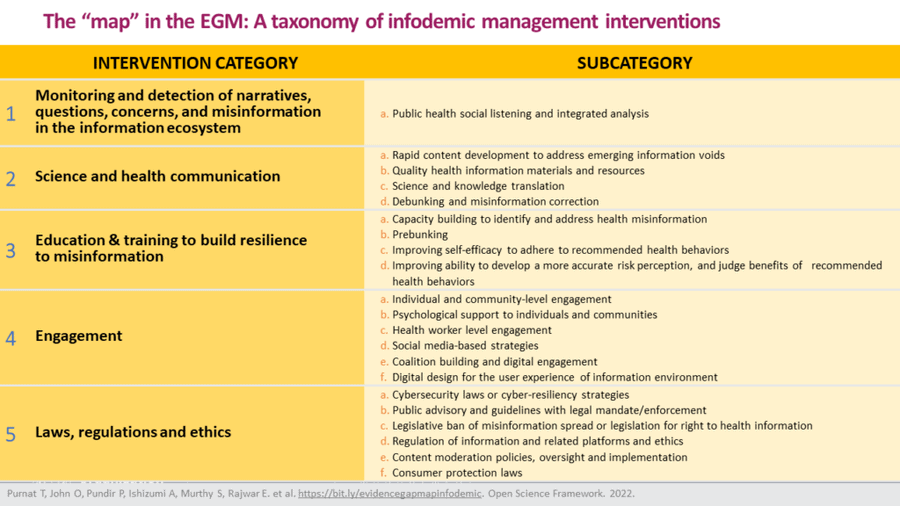
Image: A taxonomy of interventions developed in WHO’s EGM project.
If you are leading a health system
The decisions that determine whether people can act on health guidance are mostly not communication decisions. They are decisions about services, time and standing.
- Show the reasoning, not only the conclusion. Setting out how a recommendation was arrived at, including what is still unsettled, does more for confidence than stating the recommendation more clearly. I have written about this in Trust is a verb.
- Protect the time that lets clinicians listen. Trust in health professionals is among the strongest assets a health system holds, and it holds only where staff have the conditions to listen, explain and respond.
- Ask what people have already read. People arrive at a consultation having searched and discussed. Asking what they saw, and who they heard it from, is clinical work that needs time and training like any other. This is the subject of a piece I wrote with colleagues in Lancet Primary Care.
- Take part where health knowledge forms. Verified communities and clinician-endorsed forums do work that moderation and correction cannot, which I have argued in the BMJ.
- Treat the information environment as a condition, not an incident. It shapes what people are able to act on in ordinary times, which is the case I make in Health promotion in the algorithmic age.
For a starting point, these nine questions are built to be worked through with colleagues across the organization.
My advice for working in this space
There are lots of professionals who can contribute to infodemic management operationally or strategically. But I always urge every newcomer to the topic or even a specialist in one professional approach or scientific discipline to
 ground your thinking in public health and related practices in ethics, equity and evidence-based decision-making. Some roles and professions that work within the information environment have goals that differ from public health and health service delivery.
For public health professionals, health is not a commodity to manufacture and well-being is not a state to sell to the masses.
So tools that other professions use to control or interact with the information environment and the assumptions they make must be assessed for their compatibility with public health goals, and held to a high standard of ethical, evidence-based and evaluated impact.
If you’ve been hired from a predominantly communications, digital, or data science role into a job as an infodemic manager, you will need to adapt your thinking, change your point of view, and learn about how public health programs and interventions work, how they are implemented to protect the vulnerable, do no harm and safeguard from unintended consequences of work. check yourself for the bias of their own profession when thinking about the infodemic or health misinformation. When you’re used to one set of tools, everything will look like a nail made to be hit by your hammer. The information environment impacts all levels of society that interact with each other, and an infodemic manager is first and foremost an interdisciplinary thinker and a public health professional first.
If all previous practices and tools would have been sufficient to address the infodemic challenges, the organization would not need infodemic managers.
Work in this space with humility and strive for the integration of science and practice across disciplines. give back to this rapidly evolving field by sharing your experience and projects, at workshops, conferences, and by writing them up in journals. Infodemic management has grown out of the need of public health practitioners and field responders who have to deal with an increasingly challenging information environment when they are promoting health.
It’s a field that has organically evolved by public health professionals and policymakers, forging new partnerships with academics and civil society, and reimagining relationship with the private sector beyond communications campaigning.
This also means that many projects are being implemented in different contexts, and lessons learned from their implementation and evaluation are invaluable for colleagues who are trying to do the same elsewhere.
Share, network, and strive to integrate your experience into public health systems.
Where to find more

If you are new to health misinformation and infodemic management, read or watch these first
- Infodemic management in 21st Century, a chapter I coauthored for the open-access book Managing infodemics in the 21st Century
- Neville Calleja, infodemic management @ 10000m (video)
- Introduction to Africa Infodemic Response Alliance (video) and their web site
- Information ecosystem and infodemic management (video), a talk I delivered with Surangani Abeyesekera from UNICEF in 2022
- To fix health misinformation, think beyond fact-checking, a podcast where I was interviewed along with Elisabeth Wilhelm (July 2024)
- My lecture on AI, misinformation and health communication for health communicators (June 2024)
For more lists of resources on different topics, see the infodemic management cheat sheet.