 I was around when WHO first set up its digital health department. Even then, the focus was on technology, technical standards, workforce capacity and innovation. The human and social side of digital transformation got little discussion, and I saw that as a gap.
Digital health learned early that people and organizations are a big part of why so many electronic health record projects run late or fail. The field took that lesson into how it runs projects inside health systems. It has done much less to apply it to how digital transformation changes people’s lives, and their health, outside them.
AI makes the societal side harder to work around. Talking about AI means going beyond the comfortable or attention-grabbing topics to the inequities and distortions people experience, and what they do to health and wellbeing.
Digital public health is getting more recognition, and it depends on that social dimension. Health promotion has spent decades working on exactly that, the settings people live in and the commercial influences inside them. Digital health needs to borrow far more from it.
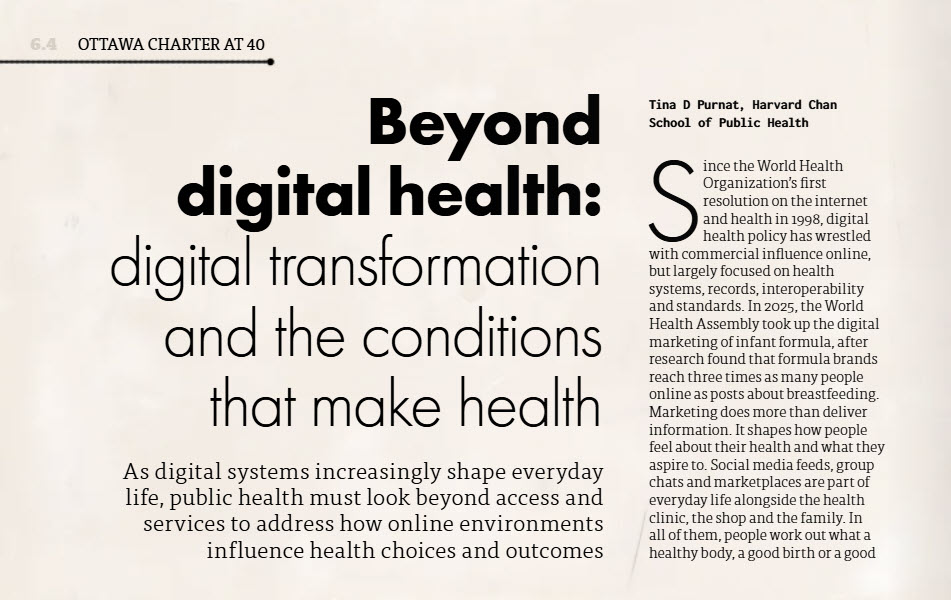
With WHO now consulting on the next global digital health strategy, for 2028 to 2033, my piece in “Health: A Political Choice – Promoting a Healthy Future” looks at what that borrowing could look like. I propose three things governments can do, each adapting a health promotion method to digital settings:
1/ Agree on what a health-promoting digital environment looks like, so the same standards apply online whatever is being sold. Today countries extend their marketing rules to the internet one product at a time, as they have for tobacco, food and infant formula.
2/ Use health impact assessment on digital transformation, as many countries already do for air pollution, transport and other complex policy areas.
3/ Give the health sector a defined role when digital, telecom and advertising rules are written, and manage commercial influence over those rules the way health already does with other industries.
It’s in the Health Promotion International section, pages 74 to 75.

Tina D Purnat
Data, tech & health policy
Public health
Healthy information environment
Health information and informatics
Infodemic management












Tina D Purnat
Data, tech & health policy
Public health
Healthy information environment
Health information and informatics
Infodemic management
Beyond digital health: digital transformation and the conditions that make health
- Year: 2026